

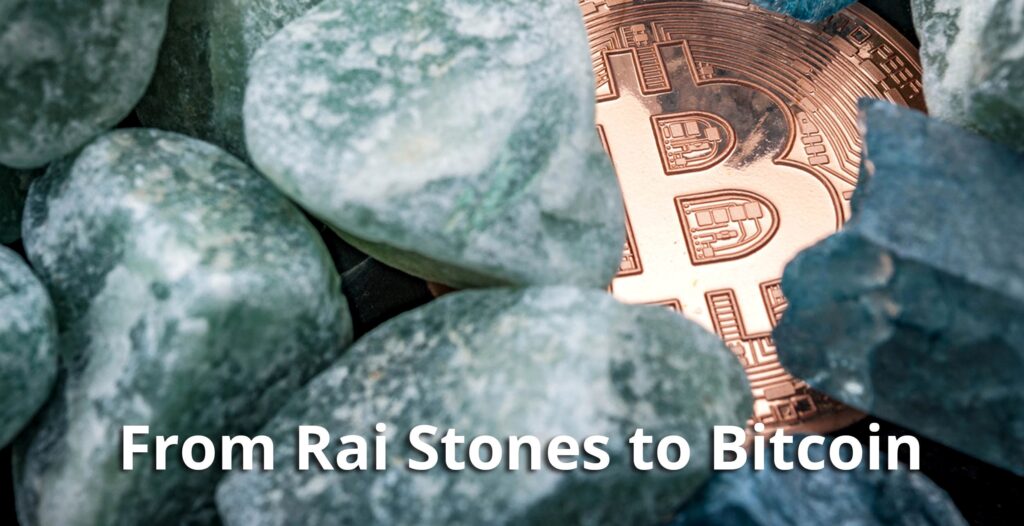
How an Ancient Pacific Currency Explains Modern Money
One useful way to understand Bitcoin — and, more broadly, the nature of money — comes from a small Pacific island called Yap, where metal has never been available. With no metal to mint coins, the people of Yap developed an extraordinary alternative.
To create money, they traveled more than 250 miles by boat to the neighboring island of Pulau, which contained a type of limestone unavailable on Yap. There, they quarried the rock and carved it into large circular discs with a hole in the center. Some of these stones, known as fei, can be seen today in the British Museum. Many were enormous, reaching up to 12 feet in diameter.
After carving them, the islanders transported the fei back to Yap, where they functioned as currency. Their value came from the difficulty of obtaining and shaping them. They were effectively impossible to steal — they were far too large to move — and equally impossible to counterfeit, since Yap had no limestone of its own.
The stones also embodied a clear record of labor. There were no shortcuts in quarrying and carving them; you either did the work or you did not. And because many fei were so large, they typically stayed in one place, often positioned outside someone’s home. When ownership changed hands, the stone itself didn’t move. Instead, the community simply acknowledged the new owner.
For example, if I bought your house, the fei sitting outside my home would now be considered yours, even though it physically remained where it was. In some cases, a storm would force sailors to throw a fei overboard during the return journey from Pulau. Yet once they came back and reported what had happened, the community still recognized the stone — now resting at the bottom of the Pacific — as legitimate currency that retained its ownership record.
This system reveals something essential about modern money: money is ultimately a ledger, a shared understanding of who owns what. The physical object — whether a stone, a coin, or a banknote — is secondary to the record of ownership.
Bitcoin is well suited to today’s world because it functions as this kind of ledger. It is essentially a digital, universally accessible, 21st‑century version of the fei, where what matters is not the location of an object but the transparent record of who owns it and how ownership changes over time.
Bitcoin relies on cryptography to maintain this record. Each transaction begins with a public‑key/private‑key system: Bitcoin is sent to an address represented by a string of letters and numbers. The transaction is then broadcast to the Bitcoin network, which is made up of numerous linked computers known as nodes.
These nodes collect transactions into groups called blocks, processed roughly every ten minutes. Each block is run through a cryptographic tool known as a hash function. Hash functions are widely used in cryptography: they take text of any length — whether a short sentence or an entire book — and convert it into a fixed‑length string of characters. Even a tiny change in the input, like altering a comma, produces a completely different output.
Within the Bitcoin network, specialized computers called miners perform this hashing work. The term “miner” is somewhat misleading; their role is more akin to verifying and recording transactions. Miners repeatedly run the block of transactions through a specific hash function known as SHA‑256. They are searching for an output that begins with a certain number of zeros — a requirement that intentionally makes the process computationally difficult.
There is no shortcut. Miners must try trillions of possibilities per second, attempting to find the correct hash. When one miner finally discovers a hash that meets the criteria, they broadcast the result to the rest of the network. Other nodes verify it, and if enough of them agree that it is valid, the block is timestamped and permanently added to the chain of every previous Bitcoin transaction — the blockchain.
This is one of the most counterintuitive aspects of Bitcoin:
each new block contains a cryptographic record that depends on the entire history of the blockchain.
In other words, the full history of Bitcoin transactions is mathematically embedded in every new block added to the chain. This design makes fraud nearly impossible. No one can alter their balance or spend the same Bitcoin twice, because every node in the network holds an identical copy of the ledger.
As an incentive for performing this verification work, the miner who successfully solves the hash puzzle is rewarded with newly created Bitcoin. This reward is what gives meaning to the “mining” metaphor — miners earn value for maintaining the system.
Today, there is an ongoing debate within the Bitcoin community about the system’s scalability. Developer Mike Hearn has argued that Bitcoin has effectively failed due to limitations in block size — the amount of data each 10‑minute block can contain. As more people use Bitcoin, the fixed block size causes delays because the network cannot process transactions fast enough.
Credit card networks like Visa handle thousands of transactions per second, while Bitcoin’s structure creates an inherent bottleneck. Some advocates propose a new version called Bitcoin XT, which increases block size to improve speed and capacity. Others oppose any change, arguing that Bitcoin should preserve its original design, even if doing so limits mainstream adoption. For them, Bitcoin should remain a mathematically elegant tool rather than evolve into a commercial payment system.
This debate reflects a deeper philosophical divide. The original Bitcoin white paper, published on October 31, 2008 by the mysterious Satoshi Nakamoto, envisioned a decentralized, frictionless system for person‑to‑person payments — independent of banks and the broader financial system.
Ironically, the greatest challenge to Bitcoin’s future may come from the financial industry itself. Banks and financial institutions have become highly interested in the blockchain — not necessarily in Bitcoin as a currency, but in the underlying technology that enables a distributed ledger to operate simultaneously across many computers at low cost.
Blockchains could automate legal agreements, payments, and record‑keeping, significantly reducing costs. Yet these costs are currently a major source of profit for financial institutions: approximately $1.7 trillion is extracted annually through payment processing and related services. A technology that performs these functions more efficiently represents a major disruption.
Because of this, traditional financial players are increasingly seeking to integrate blockchain technology into their systems. And here lies the irony:
Bitcoin’s greatest threat may be its own success — that the very institutions it sought to bypass may eventually absorb its core innovation into the existing financial system.
0 comentarios